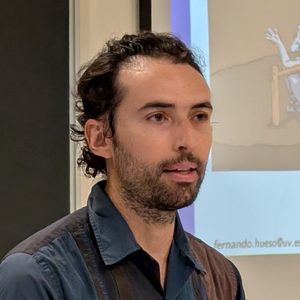
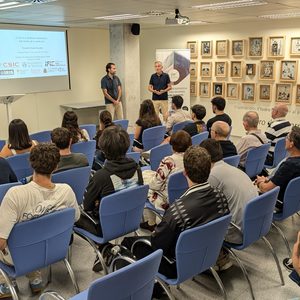
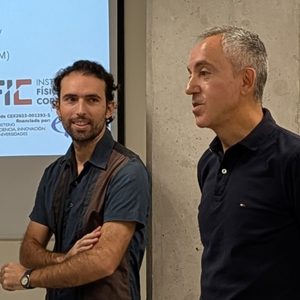
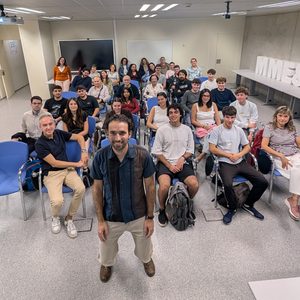
On Thursday, October 22, 2026, the University Institute of Multidisciplinary Mathematics (IMM) held another session of its research seminar featuring Fernando Hueso, a researcher at the Universitat de València and Institut de Física Corpuscular. The talk, titled “What Is the Most Beautiful Mathematical Problem in Medicine?”, sparked great interest and brought together numerous IMM researchers, as well as students in the Double Degree in Mathematics, filling the room to capacity.
During his presentation, Hueso offered a broad overview of the close relationship between mathematics and medicine, demonstrating how many of today’s medical advances depend on mathematical models, simulation techniques, and advanced computational algorithms.
In the first part of his talk, the speaker explained the fundamental role of mathematics in acquiring and reconstructing images of the human body. Using examples related to medical diagnostic techniques, he demonstrated how complex mathematical problems make it possible to transform indirect measurements into precise images of organs and tissues, thereby contributing decisively to the diagnosis and monitoring of numerous diseases.
The talk then focused on the mathematical modeling of various biological phenomena. Hueso presented examples related to the behavior of neurons, the diffusion of substances in living organisms, blood flow dynamics, and the propagation of electrical waves that control the heartbeat. He also addressed some of the scientific challenges associated with Alzheimer’s research, highlighting how mathematical tools help us understand highly complex biological mechanisms and formulate hypotheses about the progression of certain diseases.
The final part of the seminar was devoted to therapeutic applications, with a special emphasis on two advanced techniques used in cancer treatment: brachytherapy and proton therapy. The speaker demonstrated how treatment planning requires mathematical models capable of optimizing radiation distribution, maximizing its effectiveness on tumor tissues, and minimizing effects on surrounding healthy tissue.
The session concluded with a lively discussion during which attendees had the opportunity to ask numerous questions. In addition to the scientific content of the lecture, the audience showed particular interest in learning about Fernando Hueso’s academic and professional background, as well as in exploring various aspects of proton therapy—especially regarding the investments made by public health agencies to promote this technology and expand its availability within healthcare systems.
Through seminars like this one, the IMM continues to introduce its research and student community to real-world applications of mathematics in fields with significant social impact, highlighting its essential contribution to the advancement of science, technology, and medicine.